Firm- and regime-conditioned NLP alpha
Planned · Project · research proposal · independent research memorandum, June 2026 · executive summary (1 page), proposal (2 pages), technical appendix (7 pages) · All projects
Executive summary (PDF, 1 page, shared for academic use)(opens in a new tab) Research proposal (PDF, 2 pages, shared for academic use)(opens in a new tab) Technical appendix (PDF, 7 pages, shared for academic use)(opens in a new tab)
What I wrote
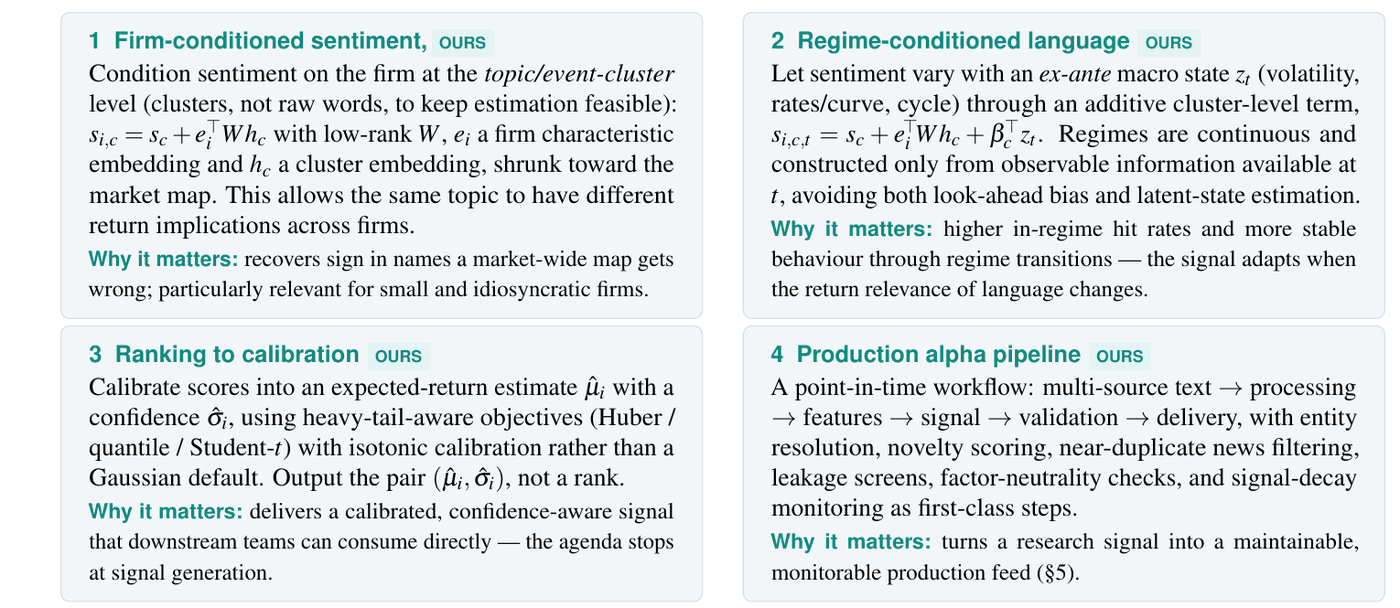
- The diagnosis: widely used published text-to-signal methods (supervised sentiment in the style of SESTM, Loughran–McDonald dictionaries, commercial-style sentiment scores, embedding models) share three assumptions: language means the same for every firm and in every market environment, and the output is a ranking (summary p. 1; proposal p. 1).
- Four model specifications with estimation plans (appendix §§B–E, pp. 1–3): a firm tilt at the level of 200–500 topic or event clusters, low-rank (s_{i,c} = s_c + e_i' W h_c, W = UV') and shrunk toward the market-wide map; an additive regime term \beta_c' z_t with a small, continuous, ex-ante state (4–6 observable variables, no hidden-Markov state); calibration of scores into (\hat\mu_i, \hat\sigma_i) with isotonic or Platt maps under Huber, quantile or Student-t losses; event-type decay half-lives.
- A point-in-time production design: eight stages from ingestion to retraining, each with its main failure mode (appendix §F, p. 4); drift monitoring (population-stability index, KS tests, rolling IC) and champion/challenger retraining; a versioned delivery contract (proposal p. 2).
- A gated first implementation in five phases with success criteria, and a self-critique of risks and mitigations (appendix §§I–J, p. 6).
Why it matters on a desk Published text strategies tend to report results before costs, with high turnover and a tilt toward small stocks, and LLM-based results can be overstated when the model has seen the future. A desk needs a point-in-time signal with a stated horizon and confidence, a record of how it was built, and monitoring that says when it has gone stale. The proposal is built around that hand-off, not around a backtest.
Where LLMs fit LLMs enter the plan only as later inputs to an interpretable scorer, not as an end-to-end oracle, and look-ahead contamination is treated as a primary modelling constraint. Blind-input validation (scoring entity-anonymised news, “Company A”, to test whether a model reads the text or remembers the company) runs alongside Phases 1–2 (appendix §§I, K, pp. 6–7).
Methods specified in the plan financial NLP low-rank and shrinkage estimation probability calibration point-in-time leakage control drift monitoring (design)
Read with care. This is a research proposal, not a result. It reports no backtest of mine; the performance figures in the documents are other authors’ published results, before costs unless stated. The documents say I replicated four published baseline methods; they record no data source, sample period or result for those replications, so this page reports none and treats a documented replication as Phase 1 of the plan. Independent personal work, not affiliated with or endorsed by any institution or employer. In the documents, OURS marks what I propose, PRIOR-LIT marks other authors’ published results (gross of costs unless stated) and FUTURE marks later extensions; ‘we’, ‘our’ and ‘our mandate’ refer to the scope of the proposal (text to signal), which I wrote alone.
Exhibit 1: Three assumptions, four directions
| Assumption in current pipelines | What the plan does instead | Specification |
|---|---|---|
| Firm-invariant language: a term has the same return implication for every firm | 1. Firm-conditioned sentiment at the level of topic or event clusters, shrunk toward the market-wide map | s_{i,c} = s_c + e_i' W h_c, low-rank W (appendix §B, p. 1) |
| Time-invariant language: a term’s return implication is stable across market environments | 2. Regime-conditioned language through an additive cluster-level term in an observable, ex-ante state | s_{i,c,t} = s_c + e_i' W h_c + \beta_c' z_t (appendix §C, p. 2) |
| Rank-only output: a score that sorts stocks but gives no size or confidence | 3. Calibration of scores into an expected-return estimate with a confidence measure, under heavy-tail-aware losses | (\hat\mu_i, \hat\sigma_i) (appendix §D, p. 3) |
| In production: timestamp or entity leakage and silent decay (appendix §H, p. 6) | 4. A point-in-time pipeline from multi-source text to a versioned delivery contract, with leakage screens, decay monitoring and retraining | eight stages (appendix §F, p. 4) |
 (opens the full-size image in a new tab)
Key takeaway. Each direction relaxes one stated assumption, and each comes with a specification and an estimation plan; none has been estimated yet.
Exhibit 2: Done, described, proposed, future
| Status | Items |
|---|---|
| Done | The three documents (June 2026): four model specifications, estimation plans and derivations; the point-in-time production, monitoring, retraining and delivery design; a self-critique of risks and mitigations. |
| Described, no data or results recorded | The appendix (§H, p. 5) describes a replication of four baseline pipelines (SESTM-style, Loughran–McDonald, a commercial-feed-style score, an embedding baseline) in qualitative terms. It names no data source, sample period or universe and reports no number of mine, and the first-implementation plan still lists the baselines as Phase 1 (§I, p. 6). |
| Proposed, not yet run | Estimating the firm tilt, the regime term, the calibration and the decay half-lives; blind (entity-anonymised) input validation, alongside Phases 1–2 (appendix §I, p. 6); every “planned diagnostic” in the appendix. |
| Future extensions | LLM embeddings as features; point-in-time retrieval-augmented generation; event-aware and agentic tooling, gated by the same point-in-time validation (proposal p. 2; appendix §K, p. 7). |
Key takeaway. What exists today is the design: specifications, estimation plans, a production design and a self-critique. Nothing on this page is a measured result.
Exhibit 3: A gated first implementation
| Phase | Scope | Success criterion |
|---|---|---|
| 1. Baseline | Replicate SESTM, Loughran–McDonald, a commercial-feed-style score and an embedding baseline; strict point-in-time, walk-forward, next-open execution | Stable word lists and a comparable out-of-sample ranking edge |
| 2. Firm-conditioned | Move from words to topic or event clusters; add the low-rank firm tilt with characteristic-based shrinkage | A positive out-of-sample IC uplift over Phase 1, concentrated in small and idiosyncratic names |
| 3. Regime-conditioned | Add the additive ex-ante state term (continuous state, no hidden-Markov model) | Better regime-stratified IC and stability through transitions |
| 4. Calibration | Map scores to (\hat\mu_i, \hat\sigma_i) with isotonic or Platt maps under a robust objective | A reliable calibration curve and interval coverage |
| 5. Validation | A full signal report: IC, hit rate, decay, turnover, capacity proxy, small-cap concentration, sector neutrality, factor exposure; gross and net | An incremental, orthogonal signal that stays positive after costs, with documented exposures |
IC = information coefficient (rank correlation between signal and later return). Source: technical appendix, §I, p. 6 (PDF, shared for academic use).
Key takeaway. If an extension adds no out-of-sample, net-of-cost value over the previous phase, the negative result is reported and the extension is not shipped.
The delivery contract. What a desk would receive for each signal: signal id, as-of timestamp, horizon, \hat\mu, confidence and coverage (proposal p. 2), with the event half-life \hat\tau attached (appendix §E, p. 3), so the holding period can be matched to how fast the information decays.
Where this connects
- Characteristic Libraries: the firm embedding in the plan is built from stock characteristics, the inputs studied there.
- Related project: NA-IPCA toolkit, the same audit-trail habit applied to estimation code.
- Related project: AI-assisted research workflow: the plan admits agentic tools only as research accelerators gated by the same point-in-time validation (appendix §K, p. 7).